Blog · By Rahul Bhadoriya · · 4 min read
Great at building, bad at marketing? A routine for developers who hate promoting their work
You don't need to become a marketer. You need a record of what you built and a habit of showing one piece of it a day. Here is the routine, step by step.
You don't need to become a marketer. Keep a record of what you build, and at the end of each working day show one thing that changed, with a screenshot and two plain sentences. People can't buy what they've never seen, and a small true post on most days gives them more chances to see it than one big launch.
You can build the whole product yourself. You can't make yourself write a post about it. If that's you, you have plenty of company: "I built it, now how do I get anyone to care?" fills every indie founder forum.
Why good builders are often bad at marketing
It usually isn't laziness or shyness. Four things get in the way:
- The feedback is slow. Code tells you in seconds whether it works. A post tells you in days, or never.
- You've forgotten the good part. The interesting moment was at 11am, when the bug finally made sense. By evening it's gone, and "worked on the app today" isn't a post.
- It feels like selling. Most marketing advice asks for big claims, and builders distrust claims they can't prove.
- It's a second job. Writing takes a different kind of attention from building, and switching between them costs you both.
None of this means you're bad at explaining your work. It means the usual way of doing it doesn't fit how you work.
You already have the material
Look at an ordinary day. You fixed something. You changed how a screen looks. You chose one approach over another. You were stuck for an hour on something that turned out to be simple.
Each of those is a post. In our count of 2,000 top build-in-public posts, each is a format people read: ship logs, screenshots, lessons, failures.
So you aren't short of things to say. You're short of a record of them, and a small habit of picking one.
The routine
- Keep a record while you work. Screenshots, commit messages, a line in a notes file. Make it automatic if you can, because on a busy day you won't do it by hand.
- At the end of the day, pick one thing that changed. Just one: the thing you'd show a friend who asked what you did today.
- Show it. A screenshot of it working, or a before and an after.
- Write two sentences. What it was, and what it is now. No adjectives, and no "excited to announce".
- Post it where the people who'd use it already read. Then answer anyone who replies.
- On Friday, list what shipped. Three or more small things make a ship log.
Once the record exists, this takes minutes a day, not an evening.
What to skip
- Waiting for launch day. In the same 2,000 posts, launches were the third most common format and had the lowest median views of all 18. Post before the launch, so it isn't the first time anyone hears about you.
- Marketing voice. If a sentence would sound odd said out loud to another developer, cut it.
- Numbers you can't show. Only post a figure you could screenshot.
- Posting about posting. Talk about the work.
- Automatic posting. It's your name on the post. Read every draft before it goes out.
Will this get you customers?
Nobody can promise that. No study shows that building in public causes sales. The evidence is founders describing what worked for them, and some well-known ones have since stopped sharing as much.
What it does is simpler. People can't buy something they've never seen. A small, true post on most working days gives them many chances to see it, where a single launch gives them one. It also leaves a public trail that answers what a careful buyer wants to know: is this real, is it still being worked on, and does the person behind it care.
Where Moneta fits
Moneta does step 1 and most of step 4. It's a Mac app that takes a screenshot every minute and keeps your workday in a folder on your Mac. The agent you already use, such as Claude Code, the Claude app or Codex, reads the folder and drafts the posts. You do the part only you can do: pick the one worth posting, read it, and post it.
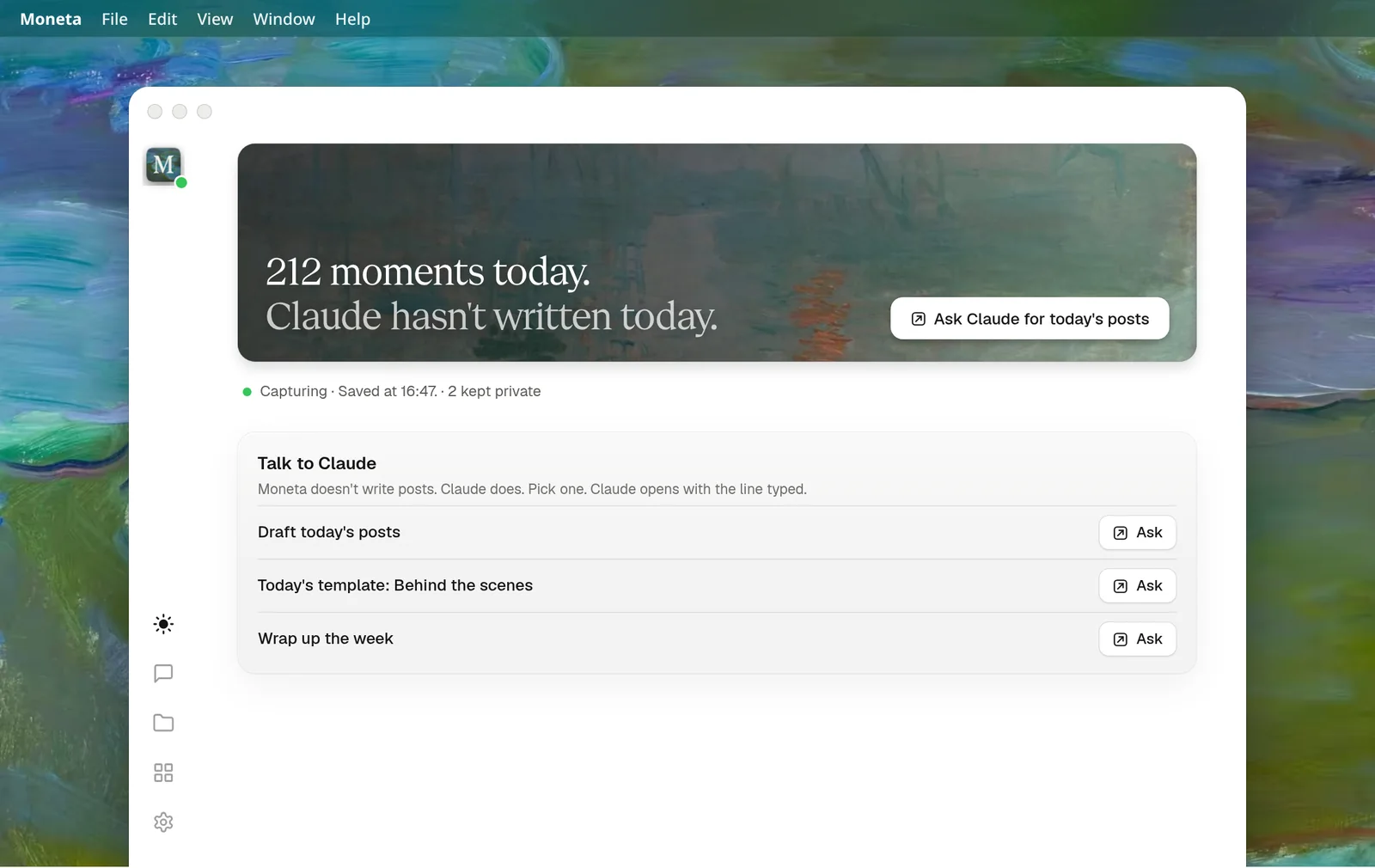
If a screenshot every minute sounds like a lot, Privacy says who can see it and what is never kept.