Blog · By Rahul Bhadoriya · · 8 min read
How much should you charge for your first indie app?
Pick a first price from similar apps, your cost to serve one user, and what the problem is worth to the buyer. A table of indie Mac and AI-tool prices, checked 18 November 2026.
Look up what similar apps charge, what it costs you to serve one user, and what the problem already costs the buyer, then pick one simple price inside that range and treat it as a test. Don't start from the hours you spent building it. I charge $20 a year for Moneta, cancel any time; as of 13 November 2026, Mat, my iPhone photo widget, has $300 in revenue with 1,800+ active users.
There isn't a correct first price, only a first guess you can change. Write down what similar apps charge, what it costs you to serve one user, and what the problem already costs the buyer. Pick one simple price in the overlap, put it on the page, and learn from who pays.
This is the question makers keep asking when they have an app and no sales data. CaliX asked it on X this week: "Solo founder question: how do you decide what to charge for the first version?" In r/SaaS, one founder wrote that "charge more than you think" is useless when you have zero customers. In r/micro_saas, people asked the same thing without wanting to scare users away.
What do the usual guides leave out?
Most of the pages that rank for this question are about the App Store, or about SaaS in general.
AppWanderer's 2026 study, with figures updated on 15 November 2026, priced 1,096,706 App Store listings and found a $2.99 median among apps that charge up front. StoreShot's guide says that for utilities the band is often a $2.99 to $9.99 one-time purchase, and for apps with ongoing value, a small monthly price with a yearly option.
That's fine as far as it goes. It doesn't help much if you're selling a Mac app from your own site, or an app that calls an AI model and costs you money every time someone uses it. Those products don't all live in the $2.99 band. The table later in this post is a snapshot of what some of them charge, taken from their own pages on 18 November 2026.
A first price also isn't the same as getting people to pay. If anyone can build an app now, who's going to pay for yours? is about that second problem.
How do you pick a number with no data?
You need three anchors, written down on one page.
1. What do similar apps charge?
List five apps your buyer would use instead of yours. For each one, write the price, whether it's one-time or a subscription, the page you found it on, and the date you checked. Start inside that range, not far below it. A price well under everything else can make the app look unfinished.
This is the first step in the r/SaaS framework as well: not to copy competitors, but to see the floor and ceiling buyers already know.
2. What does one user cost you?
This is a floor, not the price. Add up the costs that grow with each account: payment fees, hosting, and especially AI or API calls for a heavy user. StoreShot makes the same distinction: a fully offline utility costs you nothing per user, but an app that calls a model on every action can turn a generous plan into a bill you pay for strangers.
If your one-time price is $9 and one heavy user costs you $12 a month, the price isn't low, it's unsustainable. Raise it, add a limit, or switch to a subscription. The floor stops you going broke. It doesn't tell you what the buyer will pay.
3. What does the problem already cost the buyer?
This is the one that gets skipped, and it's the one that usually sets the neighbourhood: $9, $49 or $299.
Pedro G wrote about this on X a few days ago. Years ago he priced his first product "like an engineer": server costs of $40 a month, $60 an hour for his work, a margin, divided by the users he expected, rounded to a price that felt fair, $19 a month. "Logical, defensible, and wrong." Buyers didn't care what his servers cost, or how many hours he put in. They cared what the problem cost them in hours lost every week.
The r/micro_saas thread says the same thing: stop asking "what's a fair price?" and ask what you're replacing, and what that costs in time or money. You won't charge the full value. You just need to know whether you're in the coffee-money band or the "this replaces a contractor" band.
What do indie Mac and AI tools actually charge?
I checked these on 18 November 2026, on each product's own page. They're not a ranking, and they're not all in one category. They're a snapshot, so you can compare them with the $2.99 App Store median.
| App | What it is | Price | How you pay |
|---|---|---|---|
| EdgeBar | Trackpad volume and brightness on a Mac | $9 | One-time |
| TextSniper | Copy text from anything on a Mac screen | $7.99 for one Mac, $9.99 for more than one | One-time |
| CleanShot X Basic | Screenshots and recording on a Mac | $35, including one year of updates ($19 a year to renew) | One-time |
| MacWhisper Pro | Transcription and dictation on a Mac | €64 | One-time, with lifetime updates |
| Screen Studio | Polished screen recordings on a Mac | $9 a month billed yearly, or $29 a month | Subscription |
| Superwhisper Pro | Voice dictation, including on a Mac | $84.99 a year, or $8.49 a month, or $249.99 lifetime | Subscription or one-time |
| Raycast Pro | Mac launcher with AI | $96 a year | Subscription |
Prices change. If you're using this table in a few months, open the pages again.
Two things stand out. First, indie Mac utilities sold from the maker's own site often sit well above the App Store's $2.99 median, even as a one-time price. Second, apps with ongoing work or AI features often charge by the year or the month. In this snapshot, those yearly prices cluster around $85 to $108.
Should you launch with one plan or three?
One plan. The r/SaaS post puts this clearly: you don't yet know which features belong in which tier, and three columns add work for you and noise for the buyer. Launch with one price. Add a second plan later, when real usage tells you where people split.
The same post suggests picking a number that makes you slightly uncomfortable, talking to about ten people who match the buyer (about what would make it a no-brainer, not "what should I charge?"), and treating the first price as a hypothesis. StoreShot adds a practical rule for after launch: change one variable at a time, and give it a week, not a weekend.
It's easier to raise the price for new customers later than to put it up for people who already paid. Pedro's post makes the same point.
What do I charge?
Moneta, the Mac menu-bar app I made, costs $20 a year, cancel any time.
I also built Mat, an iPhone photo widget, in public in July 2026. As of 13 November 2026, it has $300 in revenue with 1,800+ active users. Four days after going live it had 1,386 users.
I'm not going to turn those into a pricing method I didn't actually use. What I can share is the numbers themselves. A lot of users and a small amount of revenue doesn't, by itself, prove the price is wrong. It may be a reason to look at whether people have a reason to pay, which is a different question from "is $9 too high?".
What should you do this week?
- Write down five alternatives. Price, one-time or subscription, the URL, and today's date.
- Write down the cost of one heavy user for a month. Include AI or API calls if you have them. That's your floor.
- Write down what the problem costs the buyer in time or money, even if it's rough.
- Pick one price inside the overlap, and one plan. If your gut says $19 a month, try $29, unless the floor is already higher.
- Charge real money. A waitlist doesn't tell you if the price works. A payment does.
- Keep the first price for a few weeks, then change one thing: the number, the trial, or what the paid plan includes.
None of this guarantees sales. It just stops you pricing from the hours you spent, or from a $2.99 average that may not apply to what you built.
Where Moneta fits
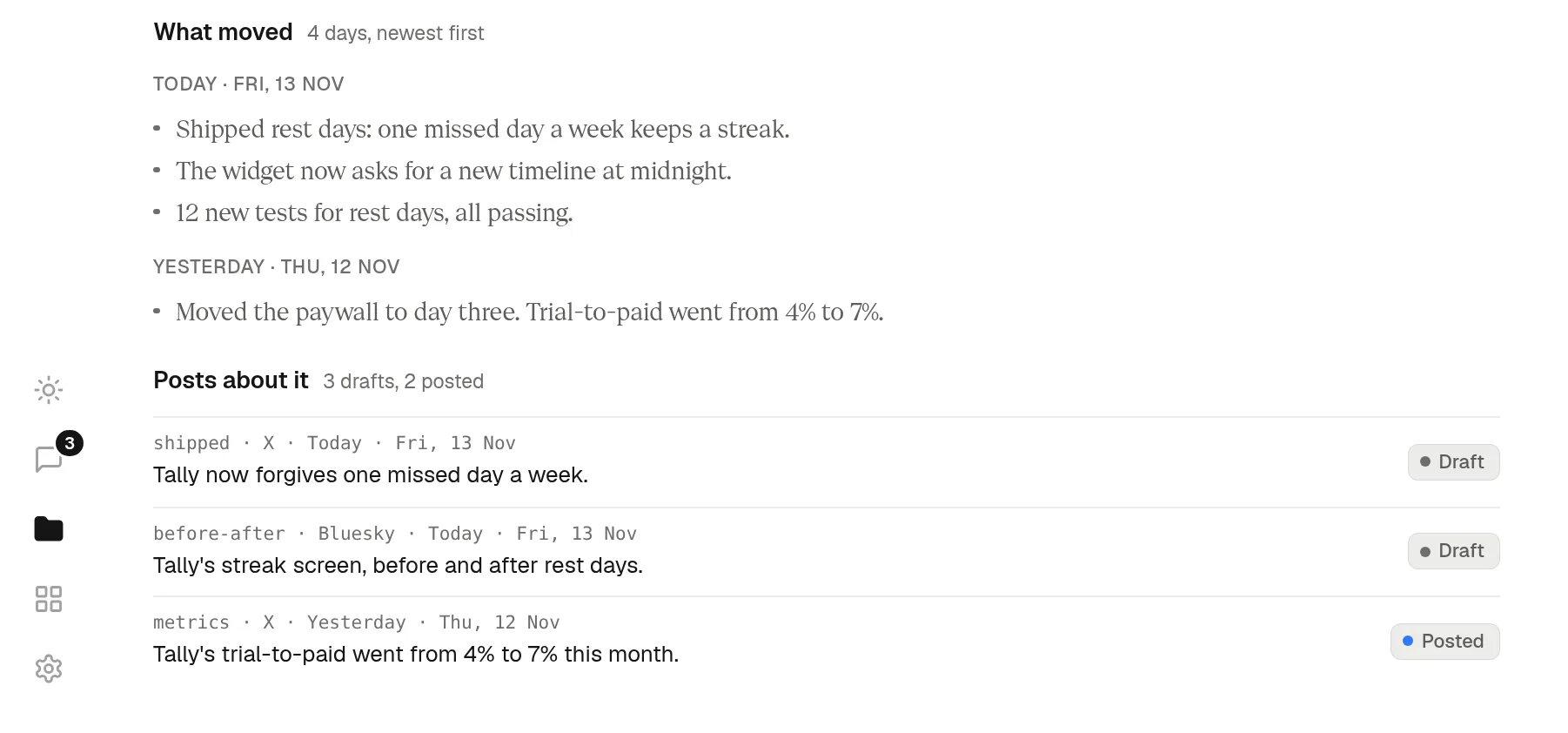
I made Moneta to keep a record of the work, which helps once you have a price and need to show that the app is being looked after. It's a Mac menu-bar app that takes a screenshot every minute and keeps your workday in a folder on your Mac. The agent you already use, such as Claude Code, Codex or the Claude app, reads that folder and drafts posts. You check them and press Post. It costs $20 a year, cancel any time.
Pricing has the details.