Blog · By Rahul Bhadoriya · · 7 min read
Why do my thoughtful posts get fewer views than random ones?
You spend hours on a post and it dies, then a throwaway takes off. What 2,000 top build-in-public posts say about effort, views and what to post instead.
Effort isn't pointless, but effort spent explaining is often wasted. In 2,000 of the most-viewed build-in-public posts on X, posts that were mostly a screenshot had a median of about 34,000 views and long written posts about 22,000, while one-liners, the closest thing to a throwaway, were second from the bottom at about 18,000. The best performers showed something real: a failure, a milestone, an income report. So put the effort into what you show, and keep the words short.
Effort isn't pointless on X. But the effort that gets read is usually effort you can see: a screenshot of the thing working, a number, a mistake. The effort that gets skipped is often the paragraphs around it. Low effort doesn't win either. In my study of top build-in-public posts, one-liners did worse than almost everything else.
Why does this feel so unfair?
Because it happens to almost everyone who posts for a while. In the past week, one builder replied to a post about it: "I've spent hours writing posts, putting real thought and effort into them, only to get barely any impressions or likes." Another put it more simply: "Sometimes the most random posts outperform the ones you actually put effort into." A third, seven months into posting on X with fewer than 500 followers, wrote that a joke post made for fun sometimes got far more views than the research he'd actually worked on.
If that's you, two things are true at once. Your feed really does judge posts fast and harshly. And the posts that win aren't as random as they look from the inside.
How does X decide who sees a post?
The short version, from Buffer's guide to the X algorithm: a new post isn't shown to all your followers. X first shows it to a small group, which Buffer puts at about 5 to 15% of your followers, and watches how they react in the first hour. Replies and saves count most. If that group engages quickly, the post is shown to more followers, then to people who don't follow you. If not, its reach slows down.
That explains most of the "random" feeling. A long, careful post asks a stranger to stop and read before they can react. A quick post can be understood and replied to in a few seconds. In the first hour, the quick one has an easier test to pass.
An essay summarised by Worth Using makes the same complaint from the reader's side: posts now seem to "live or die within minutes", and the platform favours "banger" posts over consistent, mid-level quality. That's a fair description of how it feels. Neither page, though, looks at what actually worked for people building in public.
What do the most-viewed build-in-public posts look like?
I sorted 2,000 of the most-viewed build-in-public posts on X, by 117 authors, written between January 2023 and November 2026, into 18 formats. The full table is in what to post when you build in public. These rows answer the effort question:
| Format | What it is | Posts | Median views |
|---|---|---|---|
| Income report | The month's income by product, with costs | 31 | 76,547 |
| Failure | Something that didn't work, owned plainly | 55 | 40,510 |
| Milestone | A threshold crossed, and what it took | 33 | 40,050 |
| Screenshot | The screenshot is the post, with a few words | 79 | 33,721 |
| Long post | One long post: a hook, a short story, what you took from it | 368 | 22,274 |
| One-liner | One sharp line about building | 63 | 17,925 |
| Launch | The problem, what you built, where to get it | 217 | 16,846 |
Median views is the middle post in each format: half were seen more, half less.
Three things stand out:
- Throwaways didn't win. The one-liner is the format that looks most like a random post, and its median, about 18,000 views, was second lowest of all 18 formats. Only launches did worse.
- Short and concrete beat long and careful. Screenshot posts, which are mostly a picture and a few words, had a median of about 34,000 views. Long written posts had about 22,000.
- The top formats all show something you can't fake with words. A failure, a threshold crossed, a month's income split by product. Each one is a fact about real work. There are only 31 income reports, so don't lean hard on that row, but failures and milestones point the same way.
Two cautions. These are winners: every post here already did well, and most authors already had an audience, so the table shows what popular posts look like, not what will make yours popular. And the sorting was rough, so treat small gaps between rows as noise.
So is effort pointless on X?
No. Look at where the effort goes in each format.
A good screenshot post takes almost no time to write, but it took days or weeks to have something worth the screenshot. A failure post is short, but it costs you the failure and the honesty to post it. An income report needs months of real numbers. The effort is in the work, and the post just shows it.
A long, thoughtful post often puts the effort in the wrong place. It spends hours on explaining: the setup, the context, the lesson. All of that asks the reader to trust you before they've seen anything. In the first-hour test, they scroll on.
So when a "random" post takes off, it's usually one of two things:
- It showed something. A quick screenshot of a bug, a chart, a weird result. It looked low effort, but it was a real thing from your work.
- It was easy to reply to. A short question or a relatable line. Buffer's guide says replies are the strongest early signal, so a post that invites a quick answer gets an easier start.
Neither of those means your careful post was bad. It means the careful part was hidden in the text.
How do I make a thoughtful post get read?
Keep the thinking. Change the shape.
- Lead with the evidence, not the setup. If your post is about a lesson from a failed feature, the first line is the failure and the picture is the thing that broke. The lesson comes after.
- Attach the real thing. A screenshot of the app, the before and after, the dashboard, the message that changed your mind. If you can't screenshot it, ask yourself whether the post is about your work or about an idea.
- Cut the warm-up. Most long posts have two or three lines before the point. Delete them and read it again.
- Split one long post into two or three short ones. One shows the thing. One shares the number. One gives the lesson. Each one can pass the first-hour test on its own.
- Stay for the first hour. Reply to everyone who replies. Buffer's guide notes that early replies, and replies to replies, are what push a post wider.
- Write the long version somewhere it lasts. The Worth Using essay makes the point that even X's long-form articles can vanish from the timeline as fast as a short post. A blog post or a newsletter keeps working after the first hour; link to it from a reply.
Here's a fill-in version of the reshaped post:
[What happened, in one line, with the number if there is one.]
[screenshot of it]
What I learned: [one or two lines].
Keep the numbers real. Only post a figure you could screenshot.
If you're worried that short, punchy posts will start to sound generic or written by a model, the fix is the same: specifics. I wrote more about that in how to build in public without sounding like AI.
What if I don't have anything to show yet?
You almost always do. You just haven't kept it. A half-working screen, a test that failed, a sketch, the error message that cost you an afternoon. These look too small to post, but they are exactly the kind of real, visible thing that the screenshot row is made of.
The hard part is having them on hand at 6pm, when the day is over and you've forgotten what it looked like at 11am.
Where Moneta fits
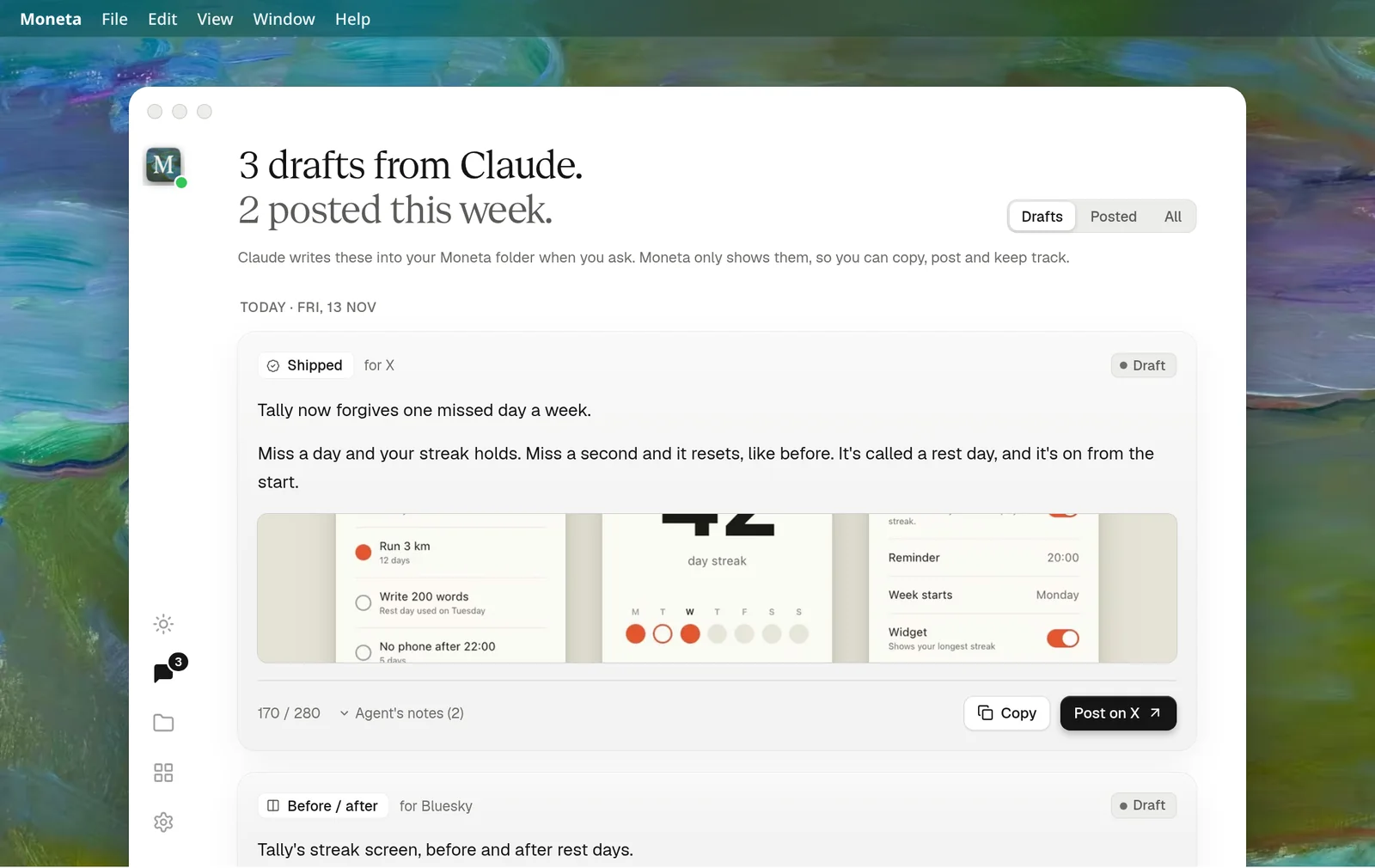
I made Moneta for that last problem. It's a Mac menu-bar app that takes a screenshot every minute and keeps your workday in a folder on your Mac, as Markdown and JPEGs you can open. The agent you already use, such as Claude Code, Codex or the Claude app, reads that folder and drafts posts from what you actually did, with the screenshots beside them. You check the draft, fix the words, and press Post.
Your screen never leaves your Mac unless your agent sends it. Privacy has the details.