Blog · By Rahul Bhadoriya · · 7 min read
If anyone can build an app now, who's going to pay for yours?
Building an app is cheap now, so selling one is harder. Here are the reasons people still pay, the numbers behind them, and what to do this week.
People still pay, but not for the code. They pay for an app someone keeps working, for time they don't want to spend building their own, and for a maker they trust to still be there next year. When anyone can build the first version, the thing to work on is everything around it: updates, a public record of the work, and people who already know your name.
People still pay for indie apps. They just don't pay for the fact that the app exists anymore, because anyone with an AI agent can make the first version in a weekend. They pay for what comes after the first version.
If you have more apps than customers, you're not alone. One indie hacker on Reddit wrote this week that they have six apps, a seventh on the way, a new one every two weeks, and very few people converting. They can't even get friends to try them. A solo developer in r/macapps asked the same thing from the other side: if coding is this easy, what is a developer's work worth?
Is it really harder to sell an app now?
Yes, and the numbers say why. They come from RevenueCat's State of Subscription Apps 2026, built from more than 115,000 apps:
| What changed | Number |
|---|---|
| New subscription apps launched per month, January 2022 | about 2,000 |
| New subscription apps launched per month, January 2026 | 14,700+ |
| Share of subscription revenue earned by apps launched before 2020 | 69% |
| Share earned by apps launched in 2025 or later | 3% |
| Median monthly revenue, one year after launch | about $72 |
| New apps that reach $1K a month within two years | 17.3% |
So seven times as many apps are launching, and most of the money still goes to apps that have been around for years. A typical subscription app makes about $72 a month a year after launch.
Copying is fast too. In a 12 November piece from TheStreet, the maker of Edgebar, a Mac app that turns the trackpad into volume and brightness sliders, counted 6 or 7 copies of it within a week of launch. Some were free, and some people replied to his posts telling others not to pay.
So who still pays, and for what?
Read what makers and writers say about this and the same few reasons keep coming up. None of them is "the code".
| They pay because | What it looks like | Source |
|---|---|---|
| Someone keeps it working | Updates, fixes, requests turned into features | TheStreet on Edgebar |
| Their time is worth more than the price | They could build their own, but it would cost them more time than the app costs money | Lex on Tech |
| They trust the person behind it | Their data, their workflow, someone who will keep it running | Flavio Copes |
| It feels made with care | Small details, platform habits, things handled before they break | Lex on Tech |
The Edgebar story is the clearest test. An open-source copy from a developer in India went viral, and its maker expected his downloads from India to drop. They didn't: India stayed at about 8% of his users, the same as on day one. He has shipped six updates since launch, adding music controls and Magic Mouse support because users asked. His own reading of it: "People are willing to pay for an app if someone's maintaining it."
Every reason in the table is something a person does over time. A clone made this week can copy the screens. It can't copy months of updates, or the replies you gave to the first hundred people who wrote in.
Are users the same as customers?
No, and it's easy to mix them up when the first numbers come in.
Here are my own. I built Mat, an iPhone photo widget, in public in July 2026. It took 20 days from idea to App Store review. It had 500K+ impressions and 1,700+ test users. Four days after going live it had 1,386 users. As of this week it has $300 in revenue with 1,800+ active users.
The first numbers are about getting found, and they're good. The last one is about getting paid, and it's much smaller. Being seen and being paid are two different jobs, and the second one needs its own work.
So when you ask "who will pay for my app?", first check which problem you have:
- Nobody finds it. That's an attention problem. More apps won't fix it.
- People find it and don't pay. That's a value problem. Look at the table above and ask which of the four reasons your app gives them.
The Reddit poster with six apps describes both. A seventh app makes the first one worse, because each new app splits the little attention they have.
What can't be copied in a weekend?
The code can. These can't, at least not quickly:
- An audience that knows you. I've posted on X since 2011. I have 29.5K followers there and had 8.6M impressions in the last 12 months. Nobody can generate fifteen years of posts with a prompt, and a clone launching next week starts at zero.
- A public record of the work. Every update you post is dated. A buyer comparing your app with a copy can see which one has been looked after.
- Taste. I spent twelve years in brand design, first at Polygon and then at my own studio, Dacoit Design, and I build my apps as a designer who can't code. The Edgebar maker names taste as one of the two defences he sees, along with the drive to keep building, though he also says better models are wearing it down.
- Keeping at it. Updates, answers, fixes. This is the cheapest one to start and the hardest one to fake.
If you want the longer version of the first two, what building in public means covers how to start, and our count of 2,000 top build-in-public posts shows which kinds of post people read.
What to do this week if your app isn't selling
- Count payers, not users. Write both numbers down. If the gap is large, you have a value problem, not a reach problem.
- Pick one app. If you have six, keep the one you'd still want to look after in a year. Don't start a seventh this month.
- Choose your reason to pay. From the table: maintained, saves their time, trusted maker, made with care. Say it plainly on your page, in one sentence.
- Ship one update and show it. A screenshot and two sentences on what changed. Then do it again next week. That's the record a clone doesn't have.
- Post before you launch, not only on the day. In the same 2,000 posts, launches had the lowest median views of all 18 formats, about 17,000. Ship logs, screenshots and failures did better.
- If someone copies you, answer with your changelog. Not an argument. People who are deciding can see who is still working on it.
None of this guarantees sales. No one can promise that, and the RevenueCat numbers say most new apps will stay small. But it moves you from the crowd of apps that exist to the much smaller group that are visibly looked after.
Where Moneta fits
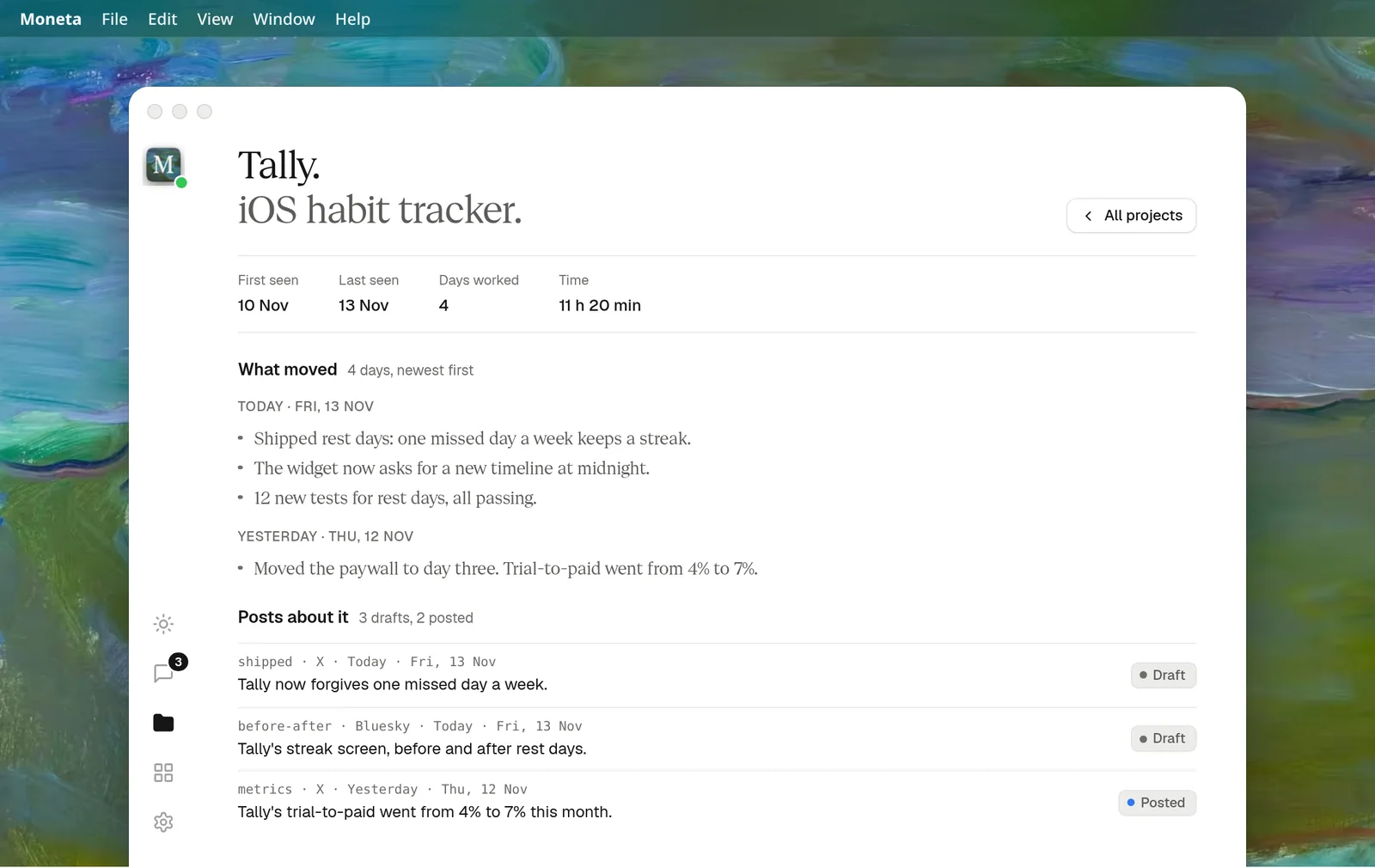
I made Moneta, and it helps with step 4. It's a Mac menu-bar app that takes a screenshot every minute and keeps your workday in a folder on your Mac. The agent you already use, such as Claude Code, Codex or the Claude app, reads that folder and drafts the posts. You read them and post the ones you like. It costs $20 a year.
About the maker has more on who's behind it.