Blog · By Rahul Bhadoriya · · 8 min read
How to write build-in-public posts that don't sound like AI
Your build-in-public posts get called AI or spam? Here's what the most-viewed ones contain, the tells to cut, and a before and after you can copy.
Put something in the post that a model couldn't have made up: a number you could screenshot, a picture of the work, or a mistake you own. In 2,000 of the most-viewed build-in-public posts on X, failures and plain screenshots had higher median views than launch posts and long written ones. Then cut the phrases models overuse, and read every draft before you post it.
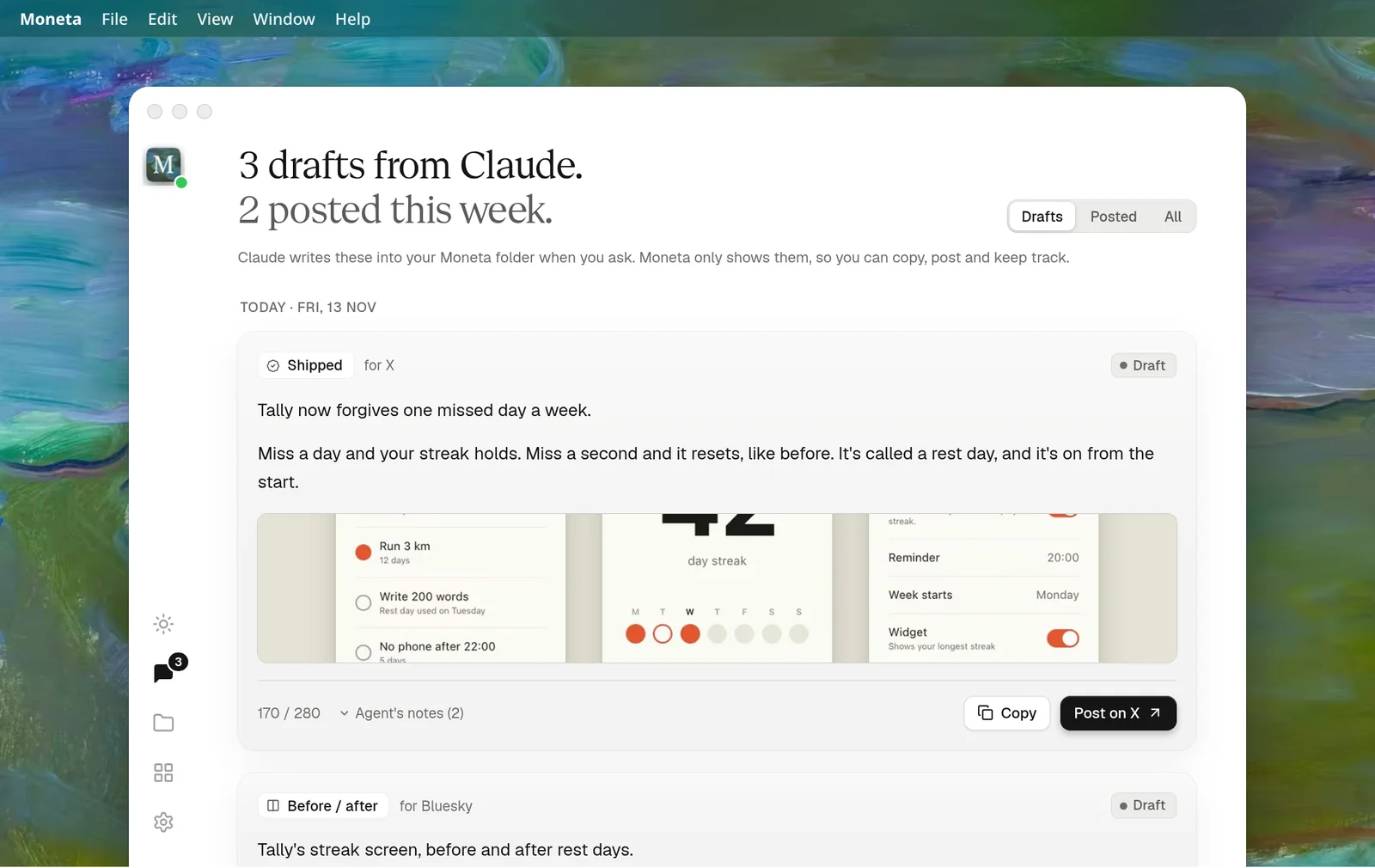
A post sounds like AI when it could have been written about anyone's project. The fix isn't a better prompt or a cleverer hook. It's putting in the things only you have: what changed, a picture of it, and the number or mistake behind it.
People are noticing the difference. Last week a founder in r/SaaS wrote that they posted their real MRR and got called a spammer, in a post titled "r/SaaS is bots talking to bots". A few days later another thread in the same subreddit was simply titled "Yall are unable to post ANYTHING without Chatgpt". On Hacker News, someone asked whether there's any hope against slop at all.
So readers are suspicious by default now. Here's how to give them a reason not to be.
Why do my posts get called AI when I wrote them myself?
Because readers aren't checking who typed the words. They're reacting to how generic the post is. Wikipedia's editors keep a long field guide to signs of AI writing, and it opens with a warning: people are bad at telling AI text from human text, and one 2025 study it cites found they did no better than chance.
That cuts both ways. A human post full of vague claims and stock phrases gets called AI. A post with a real screenshot and an awkward true detail rarely does, whoever typed it. You can't control what people suspect, but you can make the post hard to fake.
What do the most-viewed build-in-public posts actually contain?
I sorted 2,000 of the most-viewed build-in-public posts on X, by 117 authors, written between January 2023 and November 2026, into 18 formats. The full table is in what to post when you build in public. For this question, a few rows matter:
| Format | What's in it | Posts | Median views |
|---|---|---|---|
| Income report | The month's income by product, with costs | 31 | 76,547 |
| Failure | Something that didn't work, owned plainly | 55 | 40,510 |
| Milestone | A threshold crossed, and what it took | 33 | 40,050 |
| Screenshot | The screenshot is the post, with a few words | 79 | 33,721 |
| Long post | A hook, a short story, what you took from it | 368 | 22,274 |
| Launch | The problem, what you built, where to get it | 217 | 16,846 |
Three things stand out when you read the table with the "does this sound like AI?" question in mind.
The formats that did best per post carry proof. An income report shows real money split by product. A failure names what went wrong. A milestone gives a number. None of these can be written without something that actually happened.
Showing beat telling. The 79 posts that were little more than a screenshot and a few words had a median of about 34,000 views. The long written posts had about 22,000. A picture of your app working is the one thing a model can't invent for you.
Money and numbers are everywhere. Revenue updates, exits, milestones and income reports make up 824 of the 2,000 posts, about four in ten.
Two cautions, the same ones I give with the full table. These posts are winners, mostly from people who already had an audience, so the table shows what popular posts look like, not what will make yours popular. And the sorting is rough, so treat small gaps as noise. The study also didn't measure whether any post was written with AI. What it does show is that the posts people read most were built on specifics.
Which phrases make a post sound like AI?
These come up again and again in lists of AI tells. Cut them first:
| Tell | Example | Source |
|---|---|---|
| Overused words | "crucial", "pivotal", "showcasing", "leverage", "foster", "quietly" | Wikipedia: Signs of AI writing |
| Lists of three adjectives | "faster, smarter and cleaner" | Wikipedia: Signs of AI writing |
| Correcting a claim nobody made | "It's not just a feature, it's a new way to work" | Wikipedia: Signs of AI writing |
| Bold labels on every line, emoji at the start of lines, title case headings | "Speed: 2x faster" | Wikipedia: Signs of AI writing |
| "Not X. Not Y. Just Z." and no contractions anywhere | "Not a tool. Not a toy. Just a better way." | carteakey's notes on cleaning up AI drafts |
| "We" on a one-person project, and a closing "why this matters" | "We shipped dark mode today" from a solo dev | carteakey's notes on cleaning up AI drafts |
Wikipedia's page makes a point worth keeping: the words are only signs. Swapping "crucial" for "important" doesn't fix a post that says nothing. The real problem is the missing specific, and the words are just where it shows.
Before and after: one post, rewritten
Here's an example I wrote for this post. It isn't anyone's real post, and the app and numbers in it are made up. It's the kind of update that gets called AI.
Before:
Day 47 of building in public!

Excited to share a huge milestone: our onboarding just got a
complete overhaul. It's not just faster, it's smarter, cleaner
and more intuitive.

Building in public has taught me that consistency is crucial.

What's one lesson your journey has taught you?
What gives it away, line by line:
- "Day 47" is a count of days, not a thing that happened.
- "Excited to share a huge milestone" announces a feeling and doesn't name the milestone.
- "Not just faster, it's smarter, cleaner and more intuitive" is a correction nobody asked for, followed by three adjectives with nothing behind them.
- "Consistency is crucial" is a lesson anyone could post about anything.
- The closing question asks for replies without giving people anything to reply to.
After:
New onboarding is live in Habitbox.

Before: 6 screens before you could add your first habit.
Now: 2.

I cut the screen that asked for your goals. Most people
skipped it, and the ones who filled it in never saw it again.

[screenshot of the new first screen]
What changed:
- It says what shipped in the first line.
- It gives a before and an after you could check.
- It admits a small mistake: the goals screen was a bad idea.
- It shows the work instead of describing it.
- It's shorter. Nothing in it could be pasted onto someone else's app.
If you'd rather have a template, the failure, ship log and screenshot formats in what to post when you build in public all have fill-in versions.
How do I use AI to draft without sounding like AI?
A lot of the advice on this comes down to "read it aloud", as in this DEV post on sounding like ChatGPT. That helps, but it starts at the end. Standard Capital's guide gets closer: the model should do the writing, and you supply the facts. The voice problem usually starts before the draft, with what you hand the model.
- Give it your material, not a topic. "Write a build-in-public post about onboarding" gets you the before example. Your notes, a screenshot and the two numbers get you the after.
- Tell it what not to add: no facts you didn't give it, no adjectives you can't show, no closing question.
- Check every number against something you could screenshot. If the draft has a figure you didn't give it, delete it.
- Cut the tells in the table above. Then read it once out loud. If you wouldn't say a sentence to another developer at a table, cut it.
- Post it yourself. Your name is on it, so a person should be the last one to read it.
If the hard part is posting at all, not how it sounds, start with a routine for developers who hate promoting their work.
Will this stop people calling my posts AI?
Not always. Some readers will call anything with a link in it spam, and the founder in that r/SaaS thread had a real number and still got accused. But a post with a screenshot, a number and a mistake you own gives a fair reader something to check, and that's the best defence there is.
Where Moneta fits
I made Moneta for the first step in that list: having your own material to hand over. It's a Mac menu-bar app that takes a screenshot every minute and keeps your workday in a folder on your Mac. The agent you already use, such as Claude Code, Codex or the Claude app, reads that folder and drafts posts from what you actually did. It comes with 31 post templates built from the same 2,000 posts, and three skills: week, launch and tune-voice. You read the drafts, fix what doesn't sound like you, and press Post.